
World Tobacco Day
World Tobacco Day is celebrated every 31st of May to serve as a way of informing the public on the dangers of using tobacco. This date was agreed upon by the WHO member countries in 1987.
The tobacco epidemic is one of the biggest public health threats the world has ever faced. It kills more than 8 million people each year. More than 7 million of those deaths are the result of direct tobacco use while around 1.2 million are the result of non-smokers being exposed to second-hand smoke.
DID YOU KNOW THAT:
Over 80% of the world’s 1.3 billion tobacco users live in low- and middle-income countries.
In 2020, 22.3% of the global population used tobacco, 36.7% of all men and 7.8% of the world’s women.
Tobacco is dangerous in all forms, and there is no such thing as a safe level of tobacco exposure. Cigarette smoking is the most widespread method of tobacco consumption in the world. Waterpipe tobacco, other smokeless tobacco products, and cigars are examples of other tobacco products. Tobacco usage causes poverty by shifting household expenditures away from fundamental requirements like food and shelter and toward tobacco. Tobacco usage has considerable economic costs, which include large health-care expenses for treating diseases induced by tobacco use, as well as lost human capital due to tobacco-related morbidity and mortality.
Second-hand tobacco smoke is the smoke emitted from the burning end of a cigarette or from other smoked tobacco products (such as bidis and water-pipes) and the smoke exhaled by the smoker. More than 4000 chemicals have been identified in tobacco smoke and there is no safe level of exposure to second-hand tobacco smoke.
The theme for this year is environmental protection. Tobacco farming depletes water resources, causes widespread deforestation, soil erosion, and pollutes air and water systems. Tobacco plants require a lot of fertilizer because they absorb more nitrogen, phosphorus, and potassium than other major food and cash crops, which means they deplete soil fertility faster.
Tobacco is frequently grown without crop rotation (as a monocrop), leaving the tobacco plants and soil vulnerable to a variety of pests and diseases. These means that large quantities of chemicals (very harmful) are needed to control pest or disease outbreaks.
In 2007, WHO introduced a practical, cost-effective way to scale up implementation of the main demand reduction provisions of the WHO FCTC on the ground: MPOWER.
The 6 MPOWER measures are:
- Monitor tobacco use and prevention policies
- Protect people from tobacco use
- Offer help to quit tobacco use
- Warn about the dangers of tobacco
- Enforce bans on tobacco advertising, promotion and sponsorship
- Raise taxes on tobacco.
What you can do
●Quit tobacco smoking and seek medical support or help
●Encourage anyone who’s into tobacco smoking to quit
●Policy creations that discourages or ban advertising of tobacco
●Help tobacco farmers switch to alternative crops
Emerging and Re-emerging diseases; Overview
Emerging diseases
Emerging diseases are defined as those diseases whose incidence has increased in the last few years or known diseases that are rapidly increasing in incidence or geographic range in the last 2 decades.
Re-emerging diseases
Re-emerging diseases are disease that have re-appeared and attracted public health attention after a significant decline in incidence. Reemergence may happen because of a breakdown in public health measures for diseases that were once under control. They can also happen when new strains of known disease-causing organisms appear. Human behavior affects reemergence.
Reasons why a disease could emerge or re-emerge.
There are several reasons why a disease can emerge or re-emerge. Some of these reasons include:
- Poor sanitation
- Overcrowding and rapid growth population
- Inadequate public health infrastructure
- Increased exposure of humans to disease vectors and reservoirs
- Resistance to antibiotics
- Increased indiscriminate use of antibiotics
- Increased number of serial partners
- Change in behaviour
- Previously undetected or unknown infectious agents.
- Known agents being spread to new geographic locations or new populations.
- Previously known agents whose role in specific diseases has previously gone unrecognized.
- people traveling more frequently and far greater distances than in the past,
- People living in more densely populated areas, People coming into closer contact with wild animals.
- HIV : It is thought that humans were first infected with HIV through close contact with chimpanzees, perhaps through bushmeat hunting, in isolated regions of Africa. It is likely that HIV then spread from rural regions into cities and then to various countries. Further factors in human behavior, such as intravenous drug use, sexual transmission, and transfer of blood products before the disease was recognized, aided the rapid and extensive spread of HIV.
- Chikunguya : The chikungunya virus, which is related to the virus that causes Dengue fever, causes Chikungunya sickness. It is spread by the tiger mosquito and was once only found in tropical areas near the Indian Ocean. More than 100 people of Ravenna, Italy, were sickened by a strange sickness that caused fever, tiredness, and severe bone pain in late summer 2007. The chikungunya virus was eventually identified as the source of the pandemic.
WHO Top priority diseases are:
- COVID-19 Crimean-Congo haemorrhagic fever
- Ebola virus disease and Marburg virus disease
- Lassa fever
- Middle East respiratory syndrome coronavirus (MERS-CoV) and Severe Acute Respiratory Syndrome (SARS)
- Nipah and henipaviral diseases
- Rift Valley fever
- Zika
- “Disease X”
Ways in which the disease can be controlled
- Control the reservoir
- Protect susceptible host
- Encourage research
- Put in place proper sanitation
- Encourage a multidisciplinary approach
- Creating awareness
- Reporting to appropriate authorities when there any outbreak and improve disease reporting system
- Rapidly detect unusual disease patterns
- Animal control
- Improve the public health system
References
Substance abuse
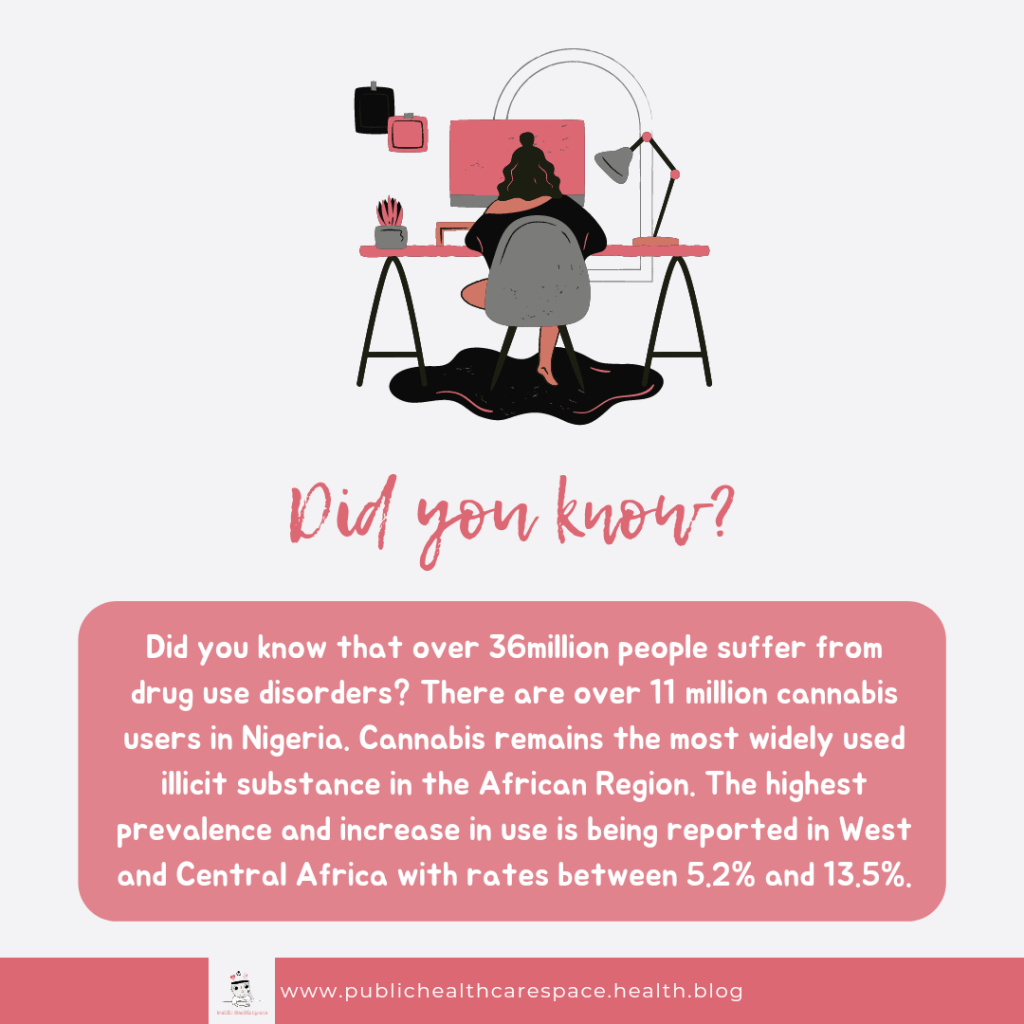
Did you know that over 36million people suffere from drug use disorders? There are over 11 million cannabis users in Nigeria. Cannabis remains the most widely used illicit substance in the African Region. The highest prevalence and increase in use is being reported in West and Central Africa with rates between 5.2% and 13.5%.
What exactly is Substance Abuse?
Substance abuse is the misuse of alcohol, psychoactive drugs and other chemicals such as volatile substances, petrol.
What is substance dependence?
Substance dependence is the medical term used to describe abuse of drugs or alcohol that continues even when significant problems related to their use have developed.
Examples of Substances that are usually abused includes:
Caffeine
Cannabis
Cocaine
Hallucinogens
Inhalation
Nicotine
Opiods
Terms frequently used in substance abuse:
- Abuse: refers to maladaptive patterns of substance use that impair health
- Dependence: refers to certain physiological and psychological phenomena induced by repeated taking of a substance.
- Withdrawal state: refers to a group of symptoms and signs occurring when a drug is reduced in amount or withdrawn, which last for a limited time.
Factors that influence substance abuse
• Personal factor: maybe due to having a disrupted family, broken homes
• Social factors: being influenced by peer pressure, social deprivation, unemployment, homelessness,
• Availability of drugs
Treatment/Management
- • Maintenance therapy: where the doctor prescribed another less dependent drug with slower action to replace the original drug
- • Biological treatment: withdraw the drug of dependence
- • Detoxification (if needed, based on the substance abused) and long-term follow-up management or recovery-oriented systems of care are important features of successful treatment.
- Long-term follow-up management usually includes formalized group meetings and psychosocial support systems, as well as continued medical supervision. Individual and family psychotherapy are often recommended to address the issues that may have contributed to and resulted from the development of a substance abuse disorder
Tips for Preventing Substance Abuse
While there is no one way or guaranteed way to prevent someone from abusing drugs and alcohol, there are things that everyone can do to prevent substance abuse.
Here are the top five ways to prevent substance abuse:
Understand how substance abuse develops.Substance abuse starts by: •Using addictive drugs (illicit or prescribed) for recreational purposesSeeking out intoxication every time you useAbusing prescription medication
Avoid Temptation and Peer Pressure. Develop healthy friendships and relationships by avoiding friends or family members who pressure you to use substances. If you surround yourself with people who abuse drugs and alcohol you are more likely to as well. Peer pressure is a major part of life for teens and adults. If you are looking to stay drug free develop a good way to just say no, prepare a good excuse or plan ahead of time to keep from giving into peer pressure.Seek help for mental illness. Mental illness and substance abuse often go hand in hand. If you are dealing with a mental illness such as anxiety, depression or post-traumatic stress disorder you should seek professional help from a licensed therapist or counselor. A professional will provide you with healthy coping skills to alleviate your symptoms without turning to drugs and alcoholExamine the risk factors. Look at your family history of mental illness and addiction, several studies have shown that this disease tends to run in the family, but can be prevented. The more you are aware of your biological, environmental and physical risk factors the more likely you are to overcome them.Keep a well-balanced life. Practise stress management skills and try to overcome these life stressors. People often turn to drugs and alcohol when something in their life is missing or not working. Practicing stress management skills can help you and will help you live a balanced and healthy life. Teaching about ways of reducing stress as stress is a great factor for vulnerable people.
Conclusion:
One of the key impacts of illicit drug use on society is the negative health consequences experienced by its members. Drug use also puts a heavy financial burden on individuals, families and society.

Say no to drug use today
Reference
https://www.afro.who.int/health-topics/substance-abuse
https://www.hopkinsmedicine.org/health/conditions-and-diseases/substance-abuse-chemical-dependency
Neglected Tropical Diseases
I have always heard of Neglected Tropical diseases(NTD) but I never really understood what it meant.
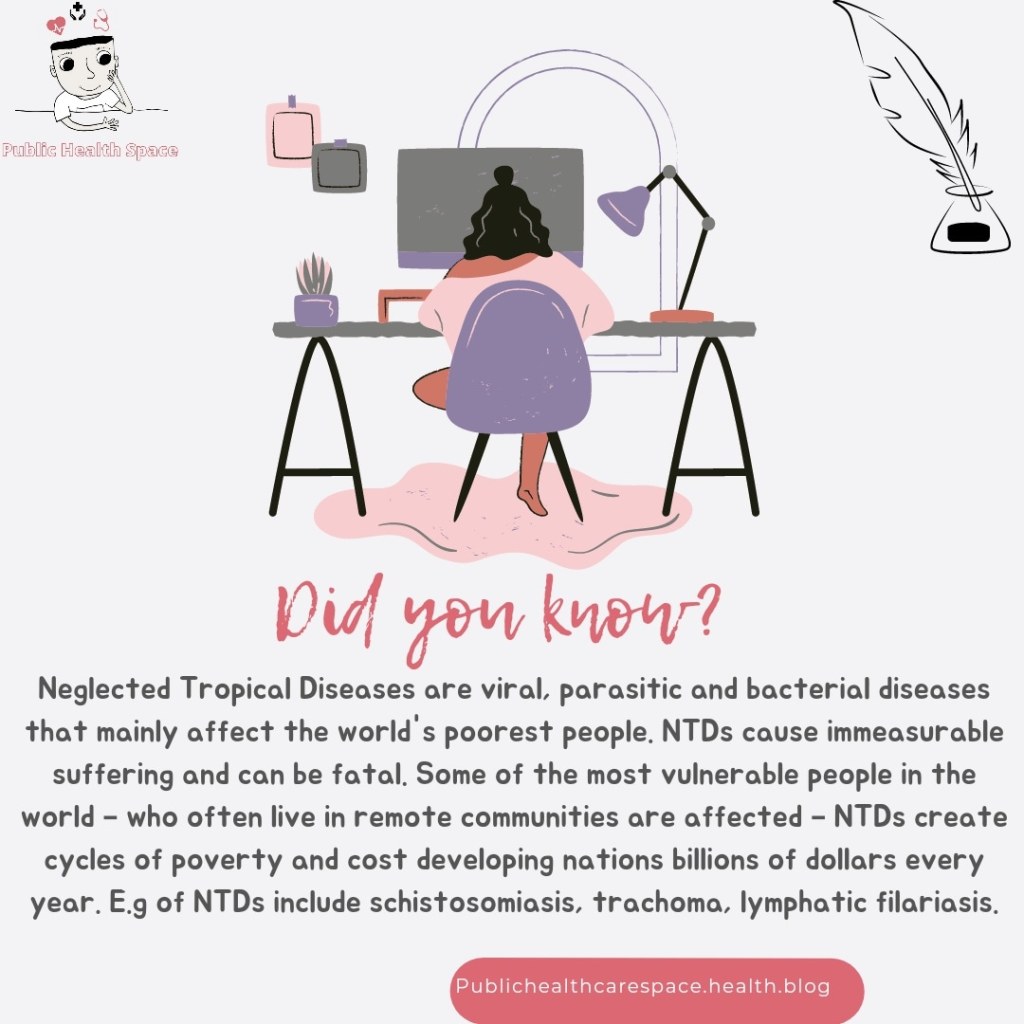
Neglected Tropical Diseases are viral, bacterial and parasitic diseases that are related to poverty, poor housing and low economic status. They are viral, parasitic and bacterial diseases that mainly affect the world’s poorest people.
According to WHO: Neglected tropical diseases (NTDs) are a diverse group of 20 conditions that are mainly prevalent in tropical areas, where they mostly affect impoverished communities and disproportionately affect women and children. These diseases cause devastating health, social and economic consequences to more than one billion people.
NTDs cause immeasurable suffering and can be fatal. By most commonly affecting some of the most vulnerable people in the world – who often live in remote communities – NTDs create cycles of poverty and cost developing nations billions of dollars every year.
Why is it called Neglected?
It is called neglected because it mostly affects the poor, they have long incubation period (I.e it takes long before symptoms becomes visible), it can be asymptomatic as a result not enough attention is being focused on them.
Examples of Neglected Tropical Diseases includes:
- Schistosomiasis
- Lymphatic filariasis
- Guinea worm
- Rabies
- Ochocerciasis
- Trichuriasis Rabies
- Leprosy
- Human African Trypanosomiasis
- Chagas disease
- Scabies
- Mycetoma
Classification of NTDS
NTDs are classified into two
Preventive chemotherapy (PCT NTDs)
Innovative disease management (IDM NTDs)
Preventive Chemotherapy Neglected Tropical:
Preventive chemotherapy Neglected Tropical Diseases are those diseases that require mass administration of medicine. This simply means that administration of safe and effective medicines needs to be done in that particular community in which the disease is common in. It is done on at a community level. Some of the signs that can be seen includes: Disability, stunted growth, renal failure, itching, anaemia and blindness.
Examples of Preventive chemotherapy Neglected Tropical includes:
Elephantiasis
Schistosomiasis
Helminthiasis
Onchocerciasis
Trachoma
Innovative disease management Involves handling of cases individually. I.e each person infected with the disease has to come to the clinic and see a doctor to be treated. It is facility based
The IDM NTDs share the following characteristics:
- Difficult and costly to manage – diagnosis, treatment and follow up;
- burden is poorly understood;
- lack of appropriate control tools;
- relatively lower investment in research and development;
- people affected often live in remote rural areas with limited access to diagnosis and treatment.
Management of NTDs
- Vector Ecology and management
- Neglected zoonotic approach
- Water sanitation and hygiene
- Innovative and intensifieud disease management
- Preventive chemotherapy
Preventive chemotherapy PCT focuses on diseases for which a strategy exists as well as on tools and the availability of safe and effective drugs that make it feasible to implement large-scale preventive chemotherapy.
Intensified disease management (IDM) IDM focuses on diseases for which cost-effective control tools do not exist and where large-scale use of existing tools is limited.
Neglected zoonotic approach Neglected zoonotic diseases are a subset of the neglected tropical diseases. Zoonoses are diseases naturally transmitted from animals to humans and vice-versa. Their management needs a collaborative, multidisciplinary approach, and a cross-sectoral efforts of human and animal health systems (application of veterinary science) to prevent and mitigate their occurrence. Basically it involves medical doctors, veterinary doctors and other professionals to control and, where feasible, elimination of the diseases in their animal reservoirs.
Vector management focuses on effective methods of targeting mosquitoes, flies, ticks, bugs and other vectors that transmit pathogens.
Vector control is an important component in the prevention and control of vector-borne diseases, specifically for transmission control.
Conclusion
Neglected tropical diseases cause immense human suffering and death. They pose a devastating obstacle to health and remain a serious impediment to poverty reduction and socioeconomic development.
References https://www.who.int/teams/control-of-neglected-tropical-diseases/about https://unitingtocombatntds.org/ntds/ https://en.m.wikipedia.org/wiki/Neglected_tropical_diseases#Prevention,_treatment_and_eradication
Vision 2063; The Africa we want
Have you ever heard about the vision 2063 before?
Are you wondering what it means and what it entails?
AGENDA 2063 is Africa’s blueprint and master plan for transforming Africa into the global powerhouse of the future. It is the continent’s strategic framework.
Origin of the Agenda 2063:
African heads of state and government signed the 50th Anniversary Solemn Declaration during the Golden Jubilee celebrations of the formation of the OAU /AU in May 2013.
The genesis of Agenda 2063 was the realisation by African leaders that there was a need to refocus and reprioritise Africa’s agenda from the struggle against apartheid and the attainment of political independence for the continent. They recognised the need to prioritise inclusive social and economic development, continental and regional integration, democratic governance, peace and security amongst other issues aimed at repositioning Africa to becoming a dominant player in the global arena.
Agenda 2063 encapsulates not only Africa’s Aspirations for the Future but also identifies key Flagship Programmes which can boost Africa’s economic growth and development and lead to the rapid transformation of the continent.
Agenda 2063 also identifies key activities to be undertaken in its various 10 years Implementation Plans which will ensure that Agenda 2063 delivers both quantitative and qualitative Transformational Outcomes for Africa’s people.
Africa Aspirations
Agenda 2063 seeks to deliver on a set of Seven Aspirations each with its own set of goals which if achieved will move Africa closer to achieving its vision for the year 2063. These 7 Aspirations reflect a desire for shared prosperity and well-being, for unity and integration, for a continent of free citizens and expanded horizons, where the full potential of women and youth are realised, and with freedom from fear, disease and want. They include:
1. A prosperous Africa based on inclusive growth and sustainable development
2. An integrated continent, politically united and based on the ideals of Pan-Africanism and the vision of Africa’s Renaissance
3. An Africa of good governance, democracy, respect for human rights, justice and the rule of law
4. A peaceful and secure Africa
5. An Africa with a strong cultural identity, common heritage, shared values and ethics
6. An Africa, whose development is people-driven, relying on the potential of African people, especially its women and youth, and caring for children.
7. Africa as a strong, united, resilient and influential global player and partner.
As I read these aspirations, I couldn’t help but imagine it too and wish these visions are achieved. The fact that this vision 2063 is also linked to the sustainable development goals makes it even more amazing.
Expected Outcome of this vision 2063
- There will free movement of goods, services and capital; and persons travelling to any member state could get the visa at the point of entry.
- All obstacles related to Women owing/inheriting property or business, signing a contract, owning or managing a bank account would be removed by 2023.
- At least one in five women would have access to and control of productive assets.
- All forms of violence against women would have been reduced by a third in 2023.
- All harmful social norms and customary practices would have ended by 2023.
- Nine out of ten persons will have access to safe drinking water and sanitation; electricity supply and internet connectivity will be up by 50% and cities will be recycling at least 50% of the waste they generate.
- Incidence of hunger, especially amongst Women and Youth will only be 20% of 2023 levels.
Conclusion :
Africa is expected to show improved standards of living; transformed, inclusive and sustained economies; increased levels of regional and continental integration; a population of empowered women and youth and a society in which children are cared for and protected; societies that are peaceful, demonstrate good democratic values and practice good governance principles and which preserve and enhance Africa’s cultural identity.
Before today, I had never heard about the vision 2063, I therefore think more awareness about this vision needs to be made known to the public and not the leaders of the country. It was very great however to know that the African leaders are not taking a back seat while the world develop and progresses ahead. I know it would take a while for this vision to come to pass but like a favourite quote if mine once said: the journey of a hundred miles begins with one step and I think the African leaders along with the African Union have taken several great steps in the right direction. Lastly, I think we the members of the Africzn Continent need to do our part to help the leaders to achieve our dreams.
How can this be achieved:
- • To ensure a peaceful and secure Africa, we should always choose peace and settlements of disputes instead of choosing violence and wars. Inter-ethnic wars should be put to a stop by showing that despite our different ethnic groups and languages we are first human beings and that should be what matters the most
- • To have an Africa with good governance and respect for human rights, we should try to make sure that we vote for the right leaders into power. The leaders that recognises that they are in power to serve the people, that understands the needs of their citizens and work every day to ensure that the human rights of the citizens are not trampled upon
- • To ensure a strong heritage, shared values and ethics. We should be open to learn about the cultures of other people from within your country and outside our country. We should learn to respect their various cultural heritages and believes.
Reading about the Vision 2063, I couldn’t help but imagine this vision becoming a reality as it quickly became the Africa I want and I hope we want. Let’s build Africa together.
Zoonotic diseases: Overview
Whenever I think about Zoonotic diseases I always remember my first ever hosted conference. It was a very small conference and it was on WhatsApp. It was hosted with the help of some people and it was a great success. I always think about my first conference because it was an eye opener for me on what Zoonotic diseases was really about. Before the event, I was aware of the word ‘Zoonosis’ but I wasn’t fully knowledgeable on what it was.
What does Zoonotic disease mean?
To me Zoonotic disease is any disease that can be transmitted from animals to human and vice versa. It poses a great threat to the public society because both humans and animals are at risk. Pet owners can get such diseases from their pets,we can get such disease from the consumption of animal products, maybe through contact with an infected animal or Inhalation.
Zoonotic diseases (also known as zoonoses) are caused by germs that spread between animals and people.
Transmission of zoonotic diseases
Just like I have mentioned above, zoonotic diseases can be transmitted through:
- Direct contact: By touching or coming in contact with body fluids from an infected animal. Examples of such body fluids include urine, blood, saliva
- Indirect contact: This is also a form of contact however unlike direct contact, indirect contact doesn’t involve you being exposed to the animal. It involves coming in contact with surfaces the animal might have touched earlier, touching of pen houses, barns, soil, water troughs of the animal.
- Vectors: Vectors are insect that transmit diseases without being infected. E.g mosquitoes, ticks, flea
- Food and water: Eating of contaminated meat, eggs can lead to a person being infected.
How can you protect yourself from being infected with Zoonotic diseases?
- In environments where the public may come in contact with animals: hand-washing facilities should be provided, and eating or drinking in the animal areas should be discouraged.
- Meat inspection is very important in reducing the risks from these agents.
- Good sanitation and hygiene during food preparation, cooking all foods of animal origin (including invertebrates such as mollusks and snails) to safe temperatures, and thoroughly washing vegetables shortly before eating.
- Vaccination (eg, rabies), treatment of clinical cases, flea and tick control.
- Water treatment procedures is highly encouraged
What is Public Health?
My first experience of public health was in school. We had a course called veterinary public health and during the lecture, our lecturer defined what public health was. It was however a very long and cumbersome definition that I had to re-read it every time it was time to write an exam or a test in that course.
To me public health entails safety measures taken to ensure the health of the public is safe and protected. This could involve measures taken by medical personnel to prevent outbreak of a disease, measures taken by community members to protect themselves from being infected with a disease, treatment regimens, advocacy, policy making among others.
According to Wikipedia, Public health is defined as “the science and art of preventing disease, prolonging life and promoting health through the organized efforts and informed choices of society, organizations, public and private, communities and individuals”. The public can be as small as a handful of people or as large as a village or an entire city; in the case of a pandemic it may encompass several continents.
The purpose of a public health intervention is to prevent and reduce the spread of diseases, injuries and other health conditions. The overall goal is to improve the health of populations and increase life expectancy.
Understanding what public health is all about, helps us as a community and the world at large to put in place measures to protect ourselves. There are various arising issues in our world today of public health concern such as emerging and re-emerging zoonotic diseases, Antimicrobial resistance, climate change, food safety, food insecurity to mention but a few. These issues need our collective efforts as well as interdisciplinary collaborations for such issues to become something of the past. Thank you for reading and I hope you now have a better understanding of what public health means.
 Public health care Space